



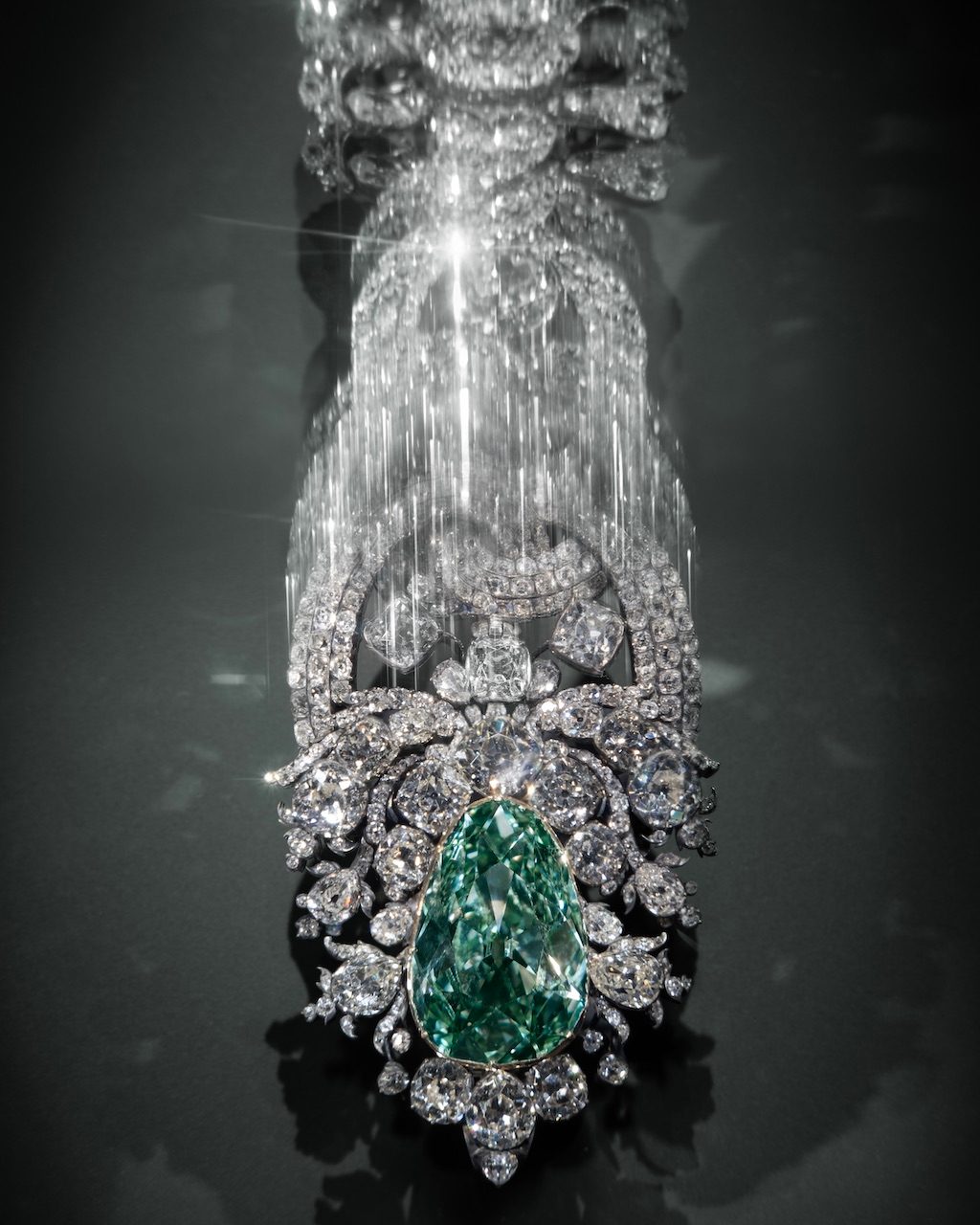
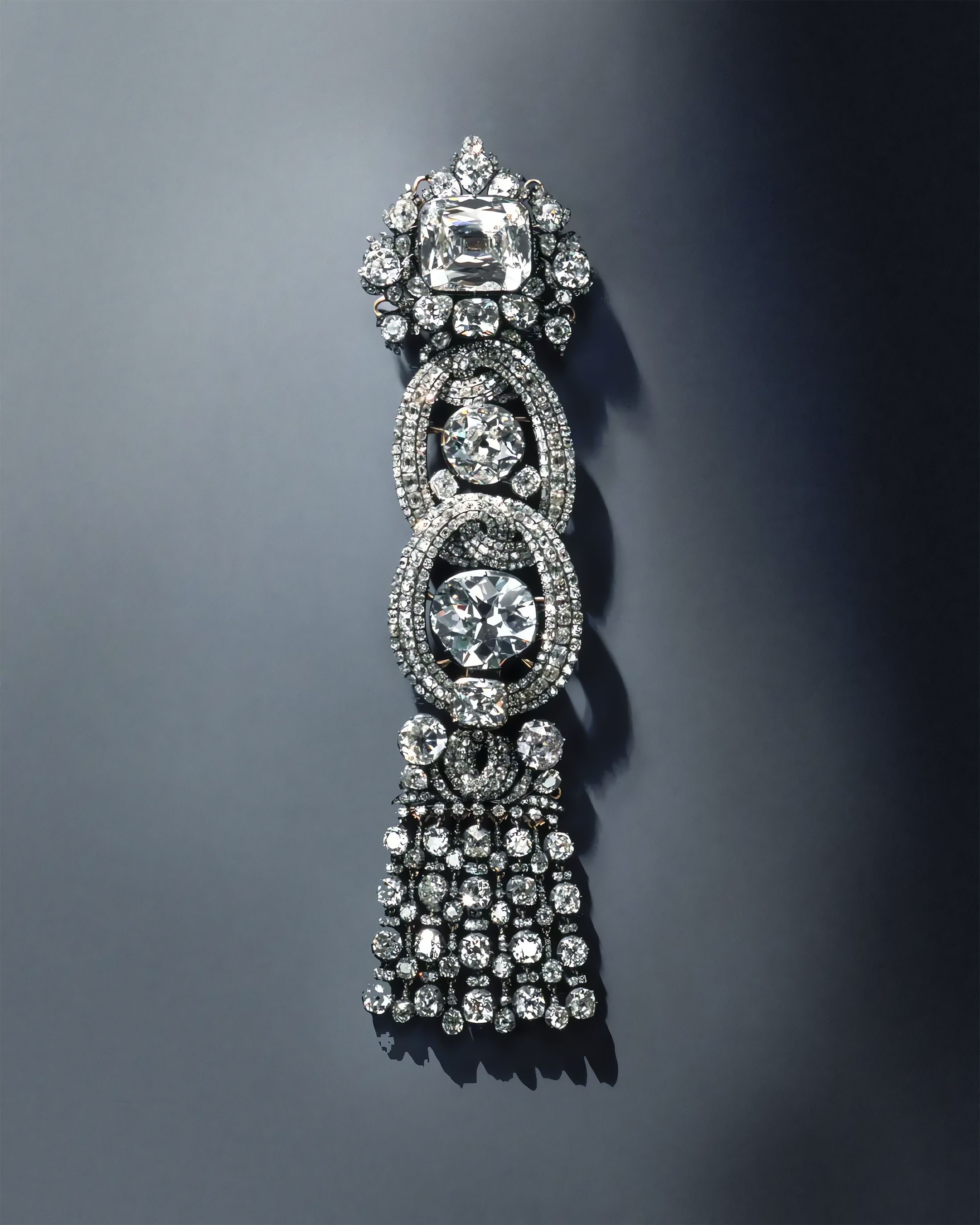
The 41-carat Dresden Green Diamond (Photographed by Benjamin Bouchet
The Wild Life of the Dresden Green Diamond
A private visit to Dresden Castle offered a rare look at the legendary green diamond. We slipped into the Green Vault while it was closed to the public and learned how it survived centuries of war, royal drama and one of the world’s most audacious jewel heists. Even its security system has secrets.
There are a handful of diamonds that move beyond gemology and into mythology. For me, the Dresden Green Diamond has always been one of them. So when the museum invited The Diamond Collective to visit Dresden Castle while the Green Vault was closed to the public, see the diamond up close and speak directly with curator Dirk Weber, I did not need a second invitation.
Photographer Benjamin Bouchet and I met Weber on a quiet Tuesday morning. Instead of entering through the grand public entrance, we slipped through a discreet side door. That was the first clue this wasn’t going to be a normal museum visit. We were going behind the scenes at one of Europe’s great treasure houses, starting with the diamond I had waited years to see in person.
Just How Close Can You Get to the Dresden Green Diamond?
The Dresden Green Diamond now lives in a dedicated room of the New Green Vault, on the second floor of Dresden Castle, in Germany. And yes, the floor matters. The original Green Vault, the historic treasury for which the diamond is famous, sits on the first floor. The Dresden Green gets a room of its own upstairs.
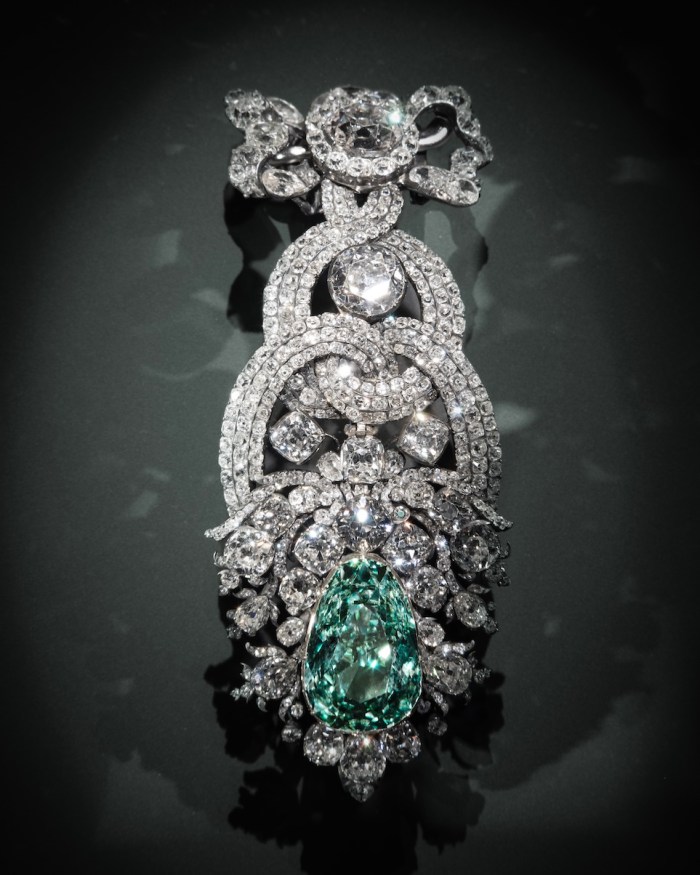
You enter the room, and the ceiling glows faintly green. Ahead, an illuminated square seems to have been cut directly into the wall. And there it is: the Dresden Green Diamond. Even after all the time I’d spent reading about it, seeing it in person felt unreal. The diamond’s natural green color isn’t quite what you expect. There’s something almost eerie about it, an apple-green hue created not by trace elements like boron or nitrogen, but by natural radiation exposure over an almost incomprehensible amount of geological time.
One of the first things I noticed was the display case, or rather, the fact that I couldn’t figure out how it worked. In most museum cases, you can at least guess where the seams are, how the case opens, or where someone might access it. Here, there was nothing. Out of curiosity, I asked Weber whether it drops into the floor, opens from behind, or perhaps connects to a secret room. He smiled. He wasn’t telling.
Apparently, even the Dresden Green’s security system has secrets.

The Diamond with 300 Years of Drama
That sense of mystery suits the diamond perfectly, because the Dresden Green has had quite a life.
The diamond weighs roughly 41 carats and came from India’s Golconda region, the legendary source of some of history’s most famous diamonds. The Dresden Green’s known history dates back to at least 1722, when a London newspaper first reported on it. By 1741, a Dutch merchant was offering the stone to Augustus II the Strong, Elector of Saxony, at the Leipzig Fair. His son and successor, Augustus III, ultimately bought it the following year. Weber told me that accounts from the time put the price at 400,000 thalers, roughly twice the cost of building Dresden’s famed Church of Our Lady around the same period.
By the mid-18th century, Dresden court jeweler Diespach mounted the diamond in the magnificent ornament it remains in today, surrounded by colorless diamonds that make its green hue look even more surreal.
Over the centuries, the Dresden Green survived political upheaval, war, and shifting empires. It was moved to safety during the Seven Years’ War, evacuated again before the bombing of Dresden during World War II, taken to Moscow by Soviet forces and finally returned in 1958.
There’s Rare—And Then There’s The Dresden Green
As the world’s most famous natural green diamond—and one of the rarest diamonds of any color, the Dresden Green Diamond falls into the rare Type IIa category, a designation that identifies some of the most chemically pure diamonds on Earth. Only about 1–2% of diamonds make the cut.
The Gemological Institute of America determined its clarity grade as VS1 in 1988 and noted its exceptionally well-preserved polish and symmetry—especially impressive when you consider that the stone was cut before 1741. It likely weighed over 100 carats in its rough form and, unusually for green diamonds, appears to have been an elongated, unbroken rough crystal.
The $400 Million Diamond Thieves Couldn’t Steal
Like so many people in the jewelry world, I followed the 2019 Dresden Green Vault heist obsessively. It had all the makings of a movie: thieves broke into the Green Vault in the early morning darkness, smashed display cases, and fled with an extraordinary group of 18th-century diamond jewels.
One widely repeated detail is that the Dresden Green Diamond escaped the robbery because it was on loan to the Metropolitan Museum of Art in New York. That’s true. But there’s a twist.
Even if the Dresden Green Diamond had been in Dresden that morning, Weber told me, the thieves still wouldn’t have gotten anywhere near it.
The robbery took place on the first floor, in the Historic Green Vault. The Dresden Green Diamond lives upstairs, in the New Green Vault. According to Weber, the criminals had only one path to the first-floor collections. So while fate certainly helped by placing the diamond in New York at the time, its trip to the Met wasn’t actually what saved it.
Still, the first floor proved far more vulnerable than people had assumed.
Weber explained that when the museum installed the original armored glass, technology forced a compromise between protection and visibility. Glass thick enough to truly safeguard the jewels would have made them nearly impossible to see clearly. The heist proved that compromise wasn’t enough. Today, the museum uses replacement glass that provides dramatically higher security while still allowing visitors to see the jewels clearly.
Then there’s another twist: the thieves apparently weren’t particularly good at diamonds.
Among the numerous groups of diamond-button ornaments, they took some of the less important examples rather than the most valuable ones, something a trained eye would have spotted immediately. In the days after the robbery, Weber and the museum team faced the painstaking work of inventorying what was missing. That meant going back through photographs and historical records, counting and measuring individual diamonds in jewels that sometimes contained more than a thousand stones.
Inside the Ultimate Jewel Box
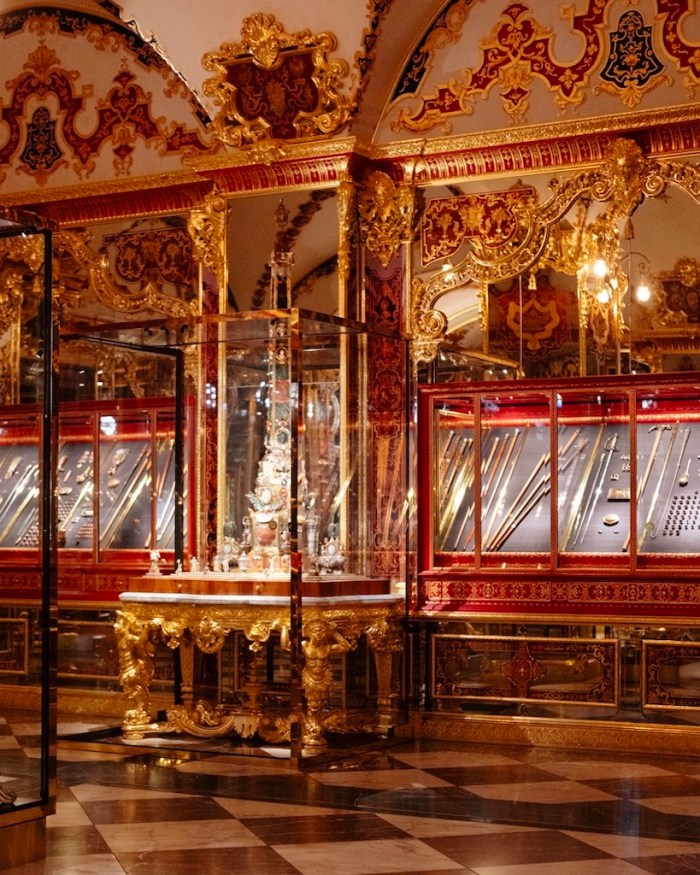
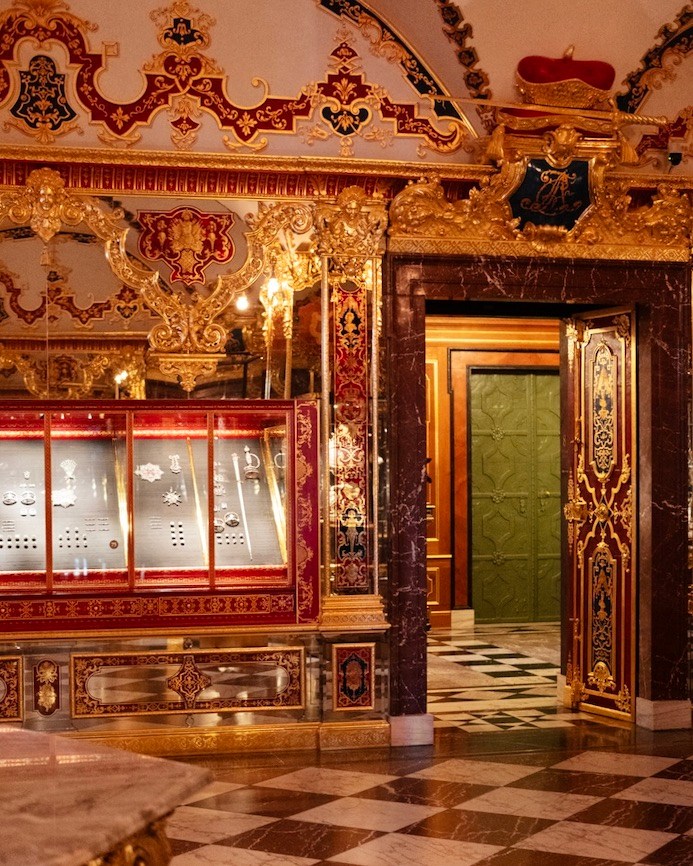
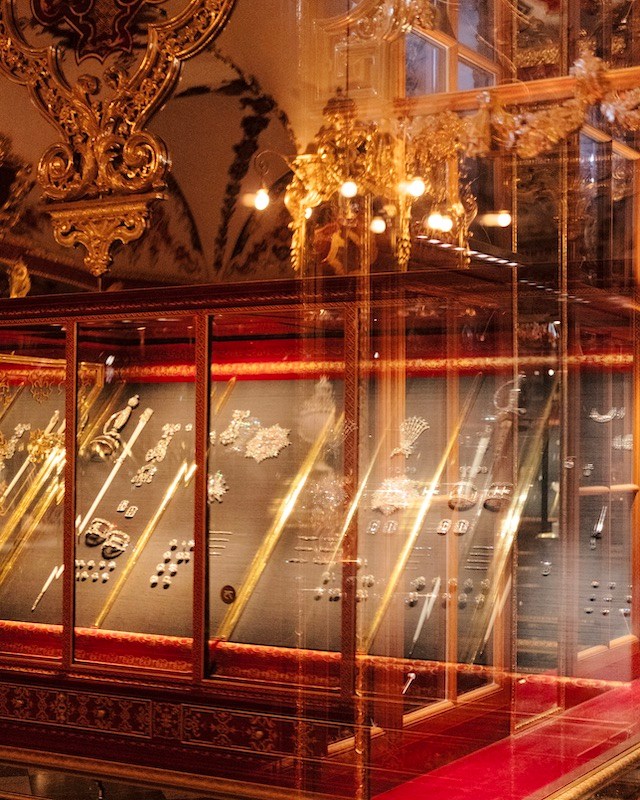
If you have never seen the Green Vault, it is difficult to convey just how over-the-top it is. The rooms are lavish, theatrical, and unlike almost anything else. Artisans reconstructed them after wartime destruction, and walking through them makes it clear why Augustus the Strong created this place not simply as a vault but as a display of power, artistry, and wonder.
And here’s the part I loved: in the 18th century, it really did function much as it does today. While the rulers of Saxony lived upstairs, visitors could pay for entry downstairs and view the treasures. Standing there with Weber, looking at the same rooms and many of the same jewels, I kept thinking that people were making essentially the same pilgrimage 300 years ago.
The museum has reopened since the heist, and curators have returned most of the recovered jewels to display. Yet you can still see damage in certain pieces, and you notice what isn’t there. Weber walked us through what thieves stole, what the museum recovered, what suffered damage, and what remains missing.
Among the most painful losses are an extraordinary diamond bow brooch c.1782, stretching more than eight inches across and set with 662 diamonds; a magnificent diamond shoulder-knot ornament c.1728 featuring the famed 49-carat Dresden White Diamond, alongside a 39-carat diamond, a 21-carat diamond, and numerous smaller stones; and a grand double-layer diamond necklace set with 37 large colorless diamonds, including one weighing more than 30 carats.
We spoke hopefully about the possibility that some of these works may one day resurface intact. But the reality is harsher: thieves often dismantle jewels, sell the stones individually, melt the metal, and sometimes even recut major diamonds to erase their identity.
That’s what makes a theft like this more than the loss of something valuable. These objects are not important simply because they contain natural diamonds. They hold the artistry, identity, and history of a culture.
You Have to See the Dresden Green to Get It
By the time I left Dresden Castle that day, I felt even more strongly about the Dresden Green Diamond than I had before arriving. There are plenty of reasons to be obsessed with it: the impossible color, the provenance, the rarity. But what stayed with me most was everything it has survived.
And somehow, it keeps coming back.
Having stood in front of it privately and heard its story from one of the very few people who has actually held it, I left thinking about the Dresden Green differently. It isn’t just one of history’s great diamonds. It might be one of its great survivors.