Discover the enduring charm of diamond brooches—ornate pieces that have symbolized status, sentiment, and style throughout history. Explore their evolution from royal adornments to modern fashion statements.
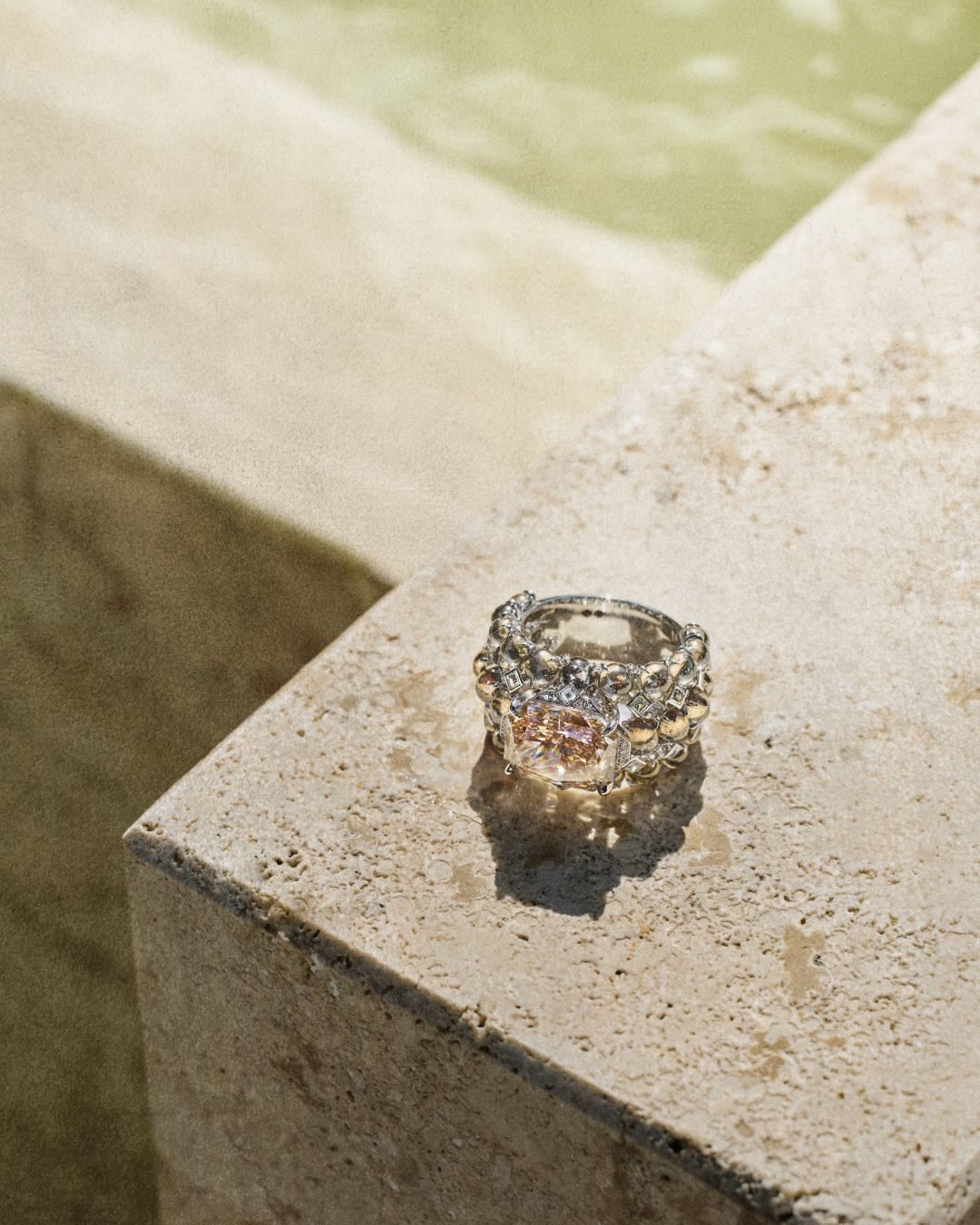
Cartier Le Choeur des Pierres ring (Photographed by Benjamin Bouchet)
Cartier Makes Magic With the World’s Rarest Diamonds
Photography by Benjamin Bouchet
What does a diamond sound like? Cartier has an answer, and it’s as extraordinary as the stones at the heart of its latest high jewelry collection.
Leave it to Cartier to find a way to make gems sing. Cartier Le Choeur des Pierres, the Maison’s latest high jewelry collection, takes its name from a play on two French words: choeur, meaning chorus, and coeur, meaning heart. Both are apt. The collection brings together a remarkable array of rare gemstones, including the largest selection of fancy-colored diamonds Cartier has presented in years.
But the title also speaks to the Maison’s approach to high jewelry, in which the stone is the starting point, its color, shape and character setting the creative process in motion. Rather than impose a design upon a gem, Cartier’s designers choreographed a composition around it, allowing each stone to reveal itself through light, movement and, occasionally, even sound.
The search for these natural wonders takes Cartier’s designers to gem markets around the world, in pursuit of stones whose colors, proportions and combinations might never be encountered again. The stones themselves have taken billions of years to form, the result of geological forces operating on a timescale beyond human comprehension. Now, Cartier’s artisans have devoted more than 85,000 hours to transforming them into 125 unique pieces. That’s the equivalent of more than 40 years of full-time work by a single person: an entire working lifetime invested in a collection of jewels. Think about that for a moment.
Diamonds That Actually Whisper
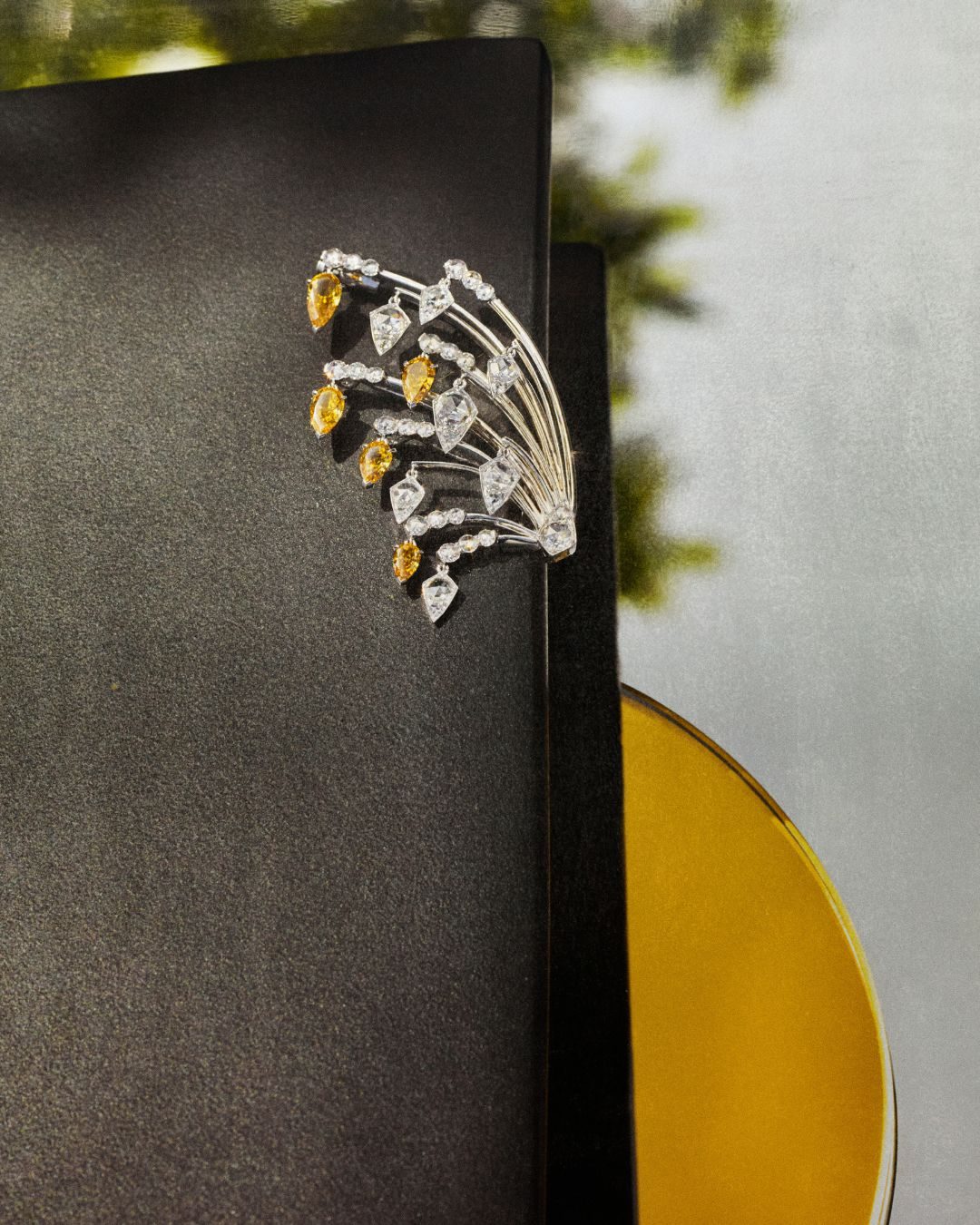
Finding a single, remarkable diamond is one thing; finding a collection of them and bringing them together in a way that feels harmonious is quite another. When I sat down with Jacqueline Karachi-Langané, Cartier’s Director of High Jewellery Creation, she began by showing me Pyra, a brooch set with 6.85 carats of orange diamonds. Its unusual construction allows it to be worn in the hair as well as on the lapel, bringing the moving stones close to the face where they catch the light.
Looking at the diamonds together, Jacqueline recalled the moment of discovering them: “It’s an explosion of color. We were completely moved by this lot of diamonds because it’s very rare. To see one it’s possible, to see a lot of this kind of stone, it’s so difficult.”
Jacqueline likes the idea of bringing the stones close to the face, where they catch the light and stimulate another sense. “It’s the sound of the stone,” she explained. She compares the effect to wearing a flower near the ear, something that seems to come alive in the air. With Pyra, the wearer can hear the faint whisper of stones moving against one another: an exquisite concert for one.
One Diamond, a Thousand Moods
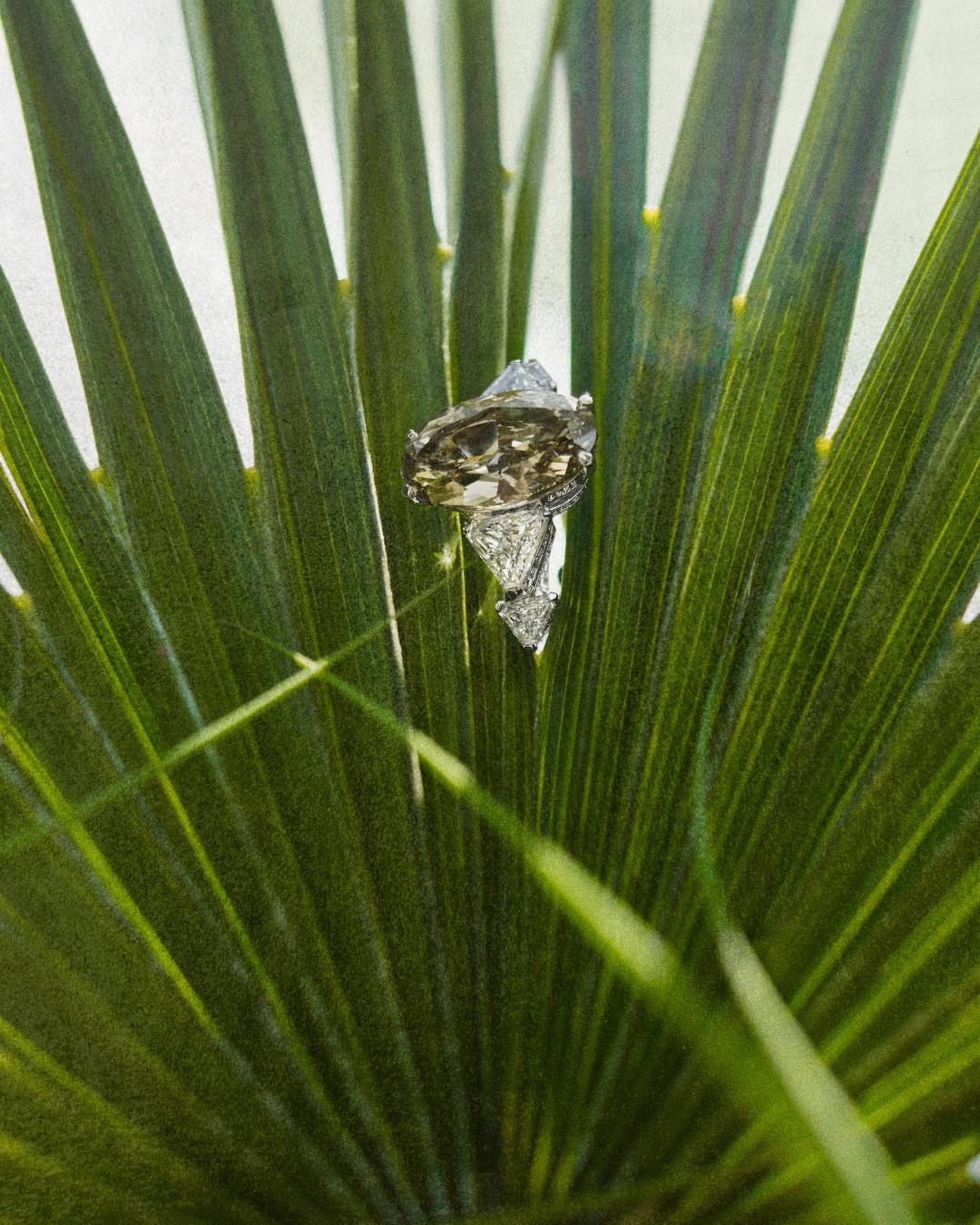
The challenge of finding extraordinary stones is not always a question of quantity. While Pyra is about the wonder of many rare orange diamonds together, the Keona is a character study of one stone. Sometimes it is color alone that makes a diamond remarkable: a hue so elusive, so changeable in different light, that it seems to resist a definitive description. This is the case with Keona, whose 11.6-carat greenish-gray center stone – a remarkable weight in this hue – shifts between blue and green, depending on how the light catches it. Jacqueline likens it to a stormy sky, describing the pleasure of watching “this cloud of this color arriving.”
Two triangular diamonds anchor either side of the elongated oval center stone, echoing a distinctive Cartier design vocabulary. The setting rises in tiers of pavé-set diamonds, with open spaces between each layer that invite light beneath the central gem, infinitely multiplying its brilliance. Jacqueline calls the setting an exercise in “sophisticated simplicity.” Its apparent restraint belies the difficulty of the design: knowing precisely what to leave out so that the diamond can reveal itself.
Cognac diamonds occupy an especially rare place in the world of colored stones. At 7.09 carats, Amberis’s certified center diamond has a deep, burnished warmth that settles naturally against the skin. Cartier carries that warmth along the ring’s shank with brown diamond cabochons, their smooth, unfaceted surfaces lending a soft, almost liquid sheen. In contrast, fine lines of square- and brilliant-cut white diamonds catch and scatter the light in sharper flashes. The cabochons seem to hold the light; the faceted stones release it. Together, they create a composition of warm and cool, glow and brilliance, softness and precision.
Two Stones and One Unlikely Love Story
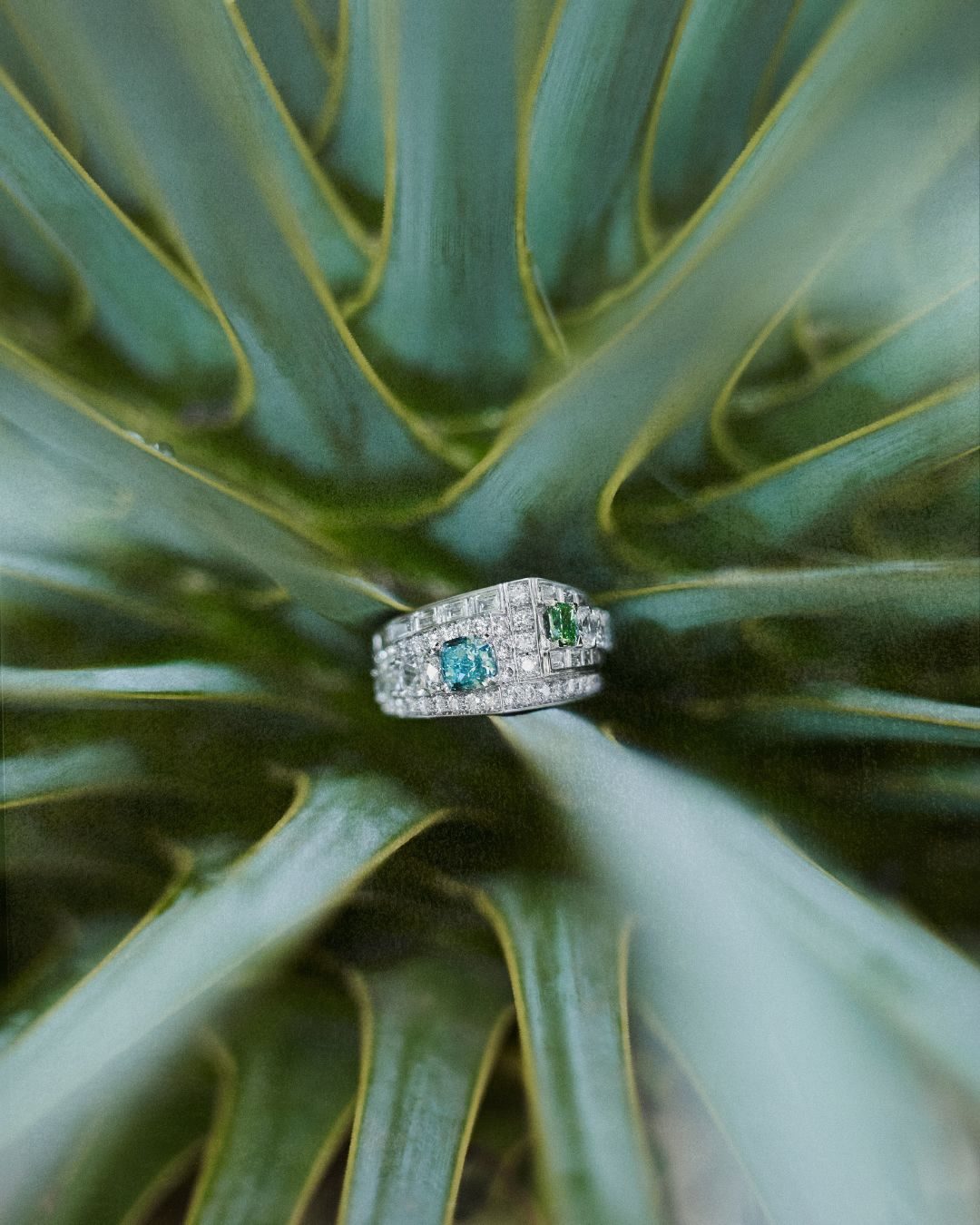
The story of Kinko begins with two diamonds that were never intended to be together. Jacqueline encountered the green and blue stones separately at a gem show: one a green-blue diamond weighing 1.11 carats, the other a green diamond of 0.42 carats. She brought them together and saw the possibility in their unlikely pairing. Blue and green have long been part of Cartier’s visual language, a combination Louis Cartier called his “peacock motif,” reflecting the Maison’s early fascination with the colors and patterns of Mughal art. Kinko revisits that heritage through a contemporary interpretation of the toi et moi ring, bringing two distinct stones into conversation.
But seeing the possibility was only the beginning. The challenge, Jacqueline explained, was finding the right balance between the stones, their proportions and the architecture of the setting. “For every piece of high jewelry, for Cartier the stone is first and a source of inspiration, never the contrary,” she said.
The designer made numerous sketches to arrive at the right composition, working with the asymmetry rather than trying to disguise it. The result is a ring whose character changes with the way it is worn. On one finger, its arrangement appears more balanced; on another, the asymmetry becomes more pronounced. Jacqueline had the jewelers try it on, then asked a woman to wear it, discovering how differently it behaved on each hand. She likes the idea that it can be shared between a woman and a man, belonging to neither exclusively. In that sense, Kinko is less a fixed statement than a piece that shifts with the person wearing it.
The Music Never Stops
The chorus of Le Choeur des Pierres is not a uniform one. Each stone has its own way of making itself known: in the shifting color of a diamond that seems to hold several hues at once, in the interplay of light across polished and faceted surfaces, or in the subtle sound of moving stones worn close to the ear. Some reveal themselves through movement, others through color, proportion or the way they change in relation to the body. Cartier’s instinct is to recognize what makes each gem singular, then give it the setting in which it can be most fully expressed. The result is a collection that doesn’t simply adorn the wearer but comes alive with them.
These stones have spent billions of years in the making. More than 85,000 of human ingenuity and craftsmanship have gone into giving them this new form, but in many ways their story is only beginning. They will move from one life to another, gathering memories, meanings and perhaps even legends. The hands that shaped them will one day be gone. The stones though – they remain. And so the chorus of Le Choeur des Pierres may continue to sing for generations to come.

The Diamond Brooch’s Unexpected Cool Factor

Hollywood’s Most Iconic Colored Diamond Engagement Rings
Jennifer Lopez has pink, blue, and green. Victoria Beckham has practically collected the rainbow. These are the celebrity engagement rings that made colorful diamonds unforgettable.

Creepy, Crawly, and Totally Covetable
Who knew something that makes your skin crawl could also make your jaw drop? The jewelry world's most unlikely muses are also some of its most amazing.
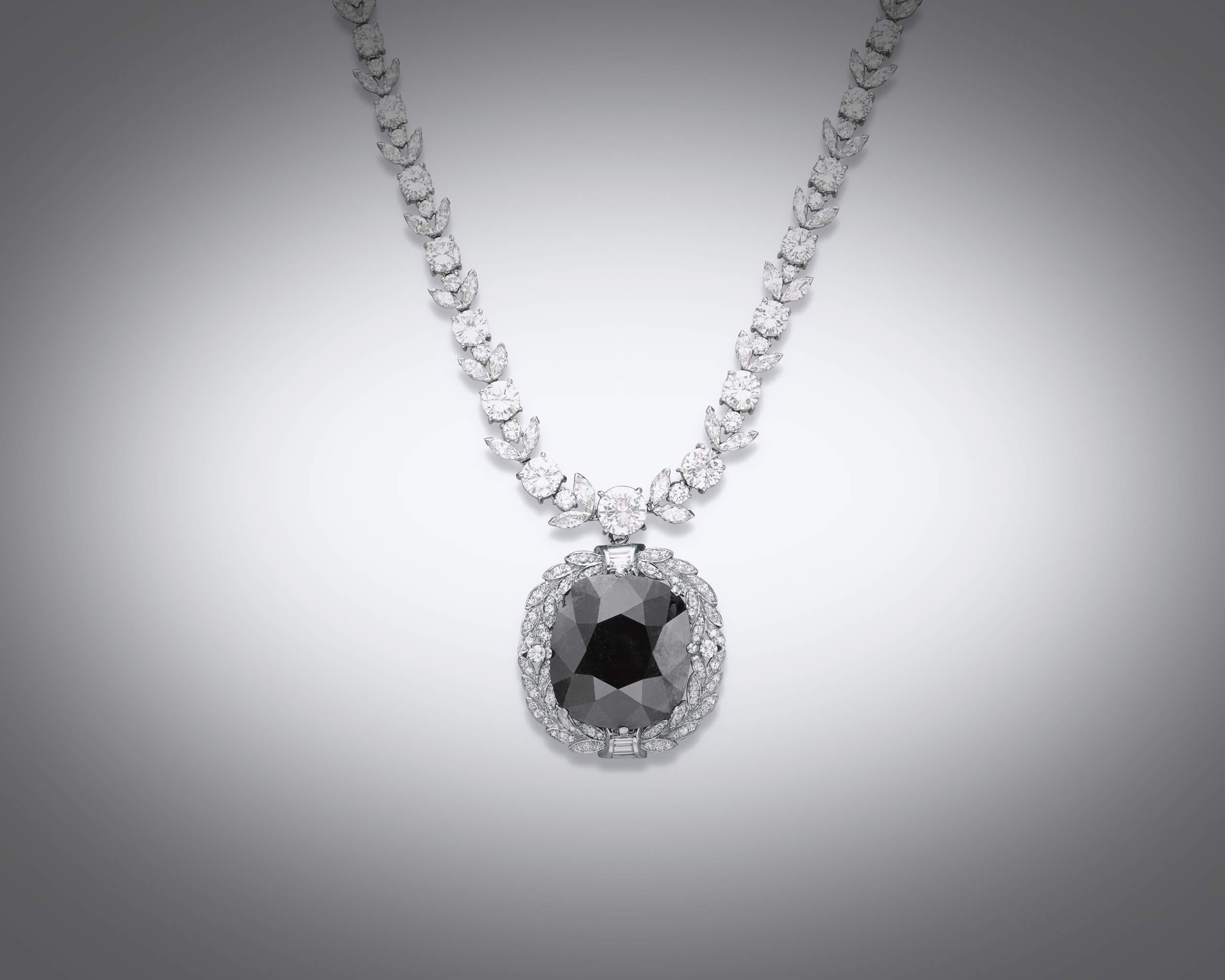
The Lore Behind the World’s Most Famous Cursed Diamonds
Every natural diamond has a deep and rich history, but some have more daunting, cursed pasts than the rest.
Get the Newsletter
Sign up for the latest diamond news, delivered directly to your inbox.